AI Allergy Panel Interpretation: IgE and Specific Antibodies
Summary & Key Takeaway
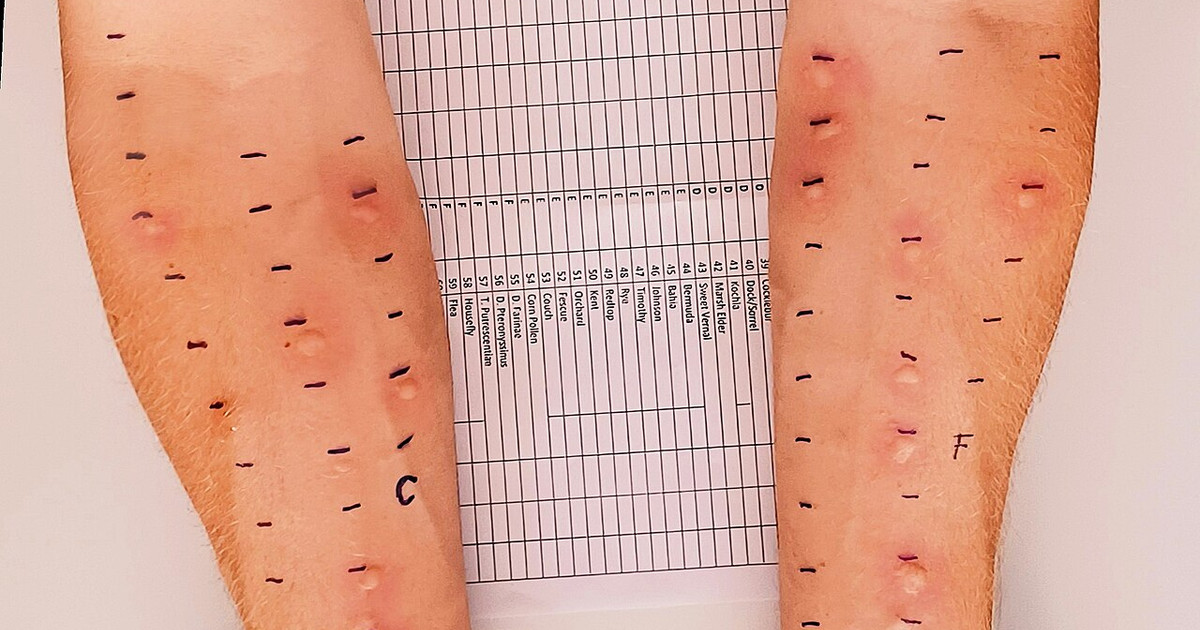
An allergy panel can tell you that your immune system has made antibodies to a food, pollen, or animal. It cannot tell you whether touching that thing will make you sick. A positive specific IgE is a sensitization signal, not an allergy diagnosis. A high total IgE can reflect allergies, parasites, eczema, or nothing relevant. AI can explain the difference, but it cannot watch you eat a peanut. This guide covers the panel and the red flags that need emergency care. Cover image: Allergy test on arm by Ar945, CC0, via Wikimedia Commons, cropped.
?? Core Insights
- A positive specific IgE means sensitization, not necessarily a clinical allergy.
- Total IgE is nonspecific; a high value does not identify what you are allergic to.
- The history of the reaction is the most important part of the diagnosis.
- Skin prick testing and specific IgE answer different questions and are interpreted together.
- Trouble breathing, throat swelling, or faintness after exposure is an emergency.
Try it yourself — free
Experience the medical AI that powers this article. Ask questions, check symptoms, or analyze lab results.
Want to know what a tool does with a panel like yours? See how the lab interpreter reads a blood panel.
Related Lab Tests
What Does Total IgE Measure?
Total IgE is the amount of immunoglobulin E in the blood. It can rise with allergies, parasitic infections, eczema, and some immune conditions. It can also be normal in a person with a serious allergy.
That is why total IgE is a poor screening test for allergy. It is a background number, not a map of triggers. A high value tells you to look for a cause; it does not tell you the cause.
What Does Specific IgE Mean?
Specific IgE measures antibodies to a particular allergen, such as peanut, cat dander, or dust mite. A positive result means the immune system has been sensitized. It does not prove that exposure will cause symptoms.
The level can correlate with risk, but the correlation is imperfect. A low positive may be clinically irrelevant; a high positive may still not cause a reaction. The history of what happened after exposure is the deciding context.
How Do Skin Tests and Blood Tests Differ?
A skin prick test introduces a tiny amount of allergen into the skin and looks for a wheal. A blood test measures specific IgE. Both detect sensitization, and both need the clinical history.
Skin tests can be affected by antihistamines and skin conditions. Blood tests are not affected by antihistamines but can be less sensitive in some cases. The clinician chooses based on the patient and the question.
Why Are Allergy Panels So Easy to Misread?
The first reason is prevalence. Many people are sensitized to common allergens without having symptoms. The second is panel size: a 30-allergen panel increases the chance of a positive result that is not clinically relevant.
The third is the difference between sensitivity and severity. A positive test does not predict how severe a future reaction will be. That is why an allergy action plan is based on the history and the risk, not just the number.
How Can AI Help With an Allergy Panel?
AI can explain the difference between total and specific IgE, help you build a timeline of reactions, and flag the red flags that require emergency care. It can also help you prepare questions for an allergist.
It should not tell you to avoid a food or stop a medication based on a lab panel alone. It should not clear you to eat a food that previously caused a reaction. Those decisions need a clinician with the full story.
Premedice is our product. It can explain a lab report and cite sources, but it does not diagnose allergy or prescribe an action plan.
When Is an Allergic Reaction an Emergency?
Trouble breathing, throat tightness, swelling of the lips or tongue, widespread hives with dizziness, vomiting, or faintness after exposure needs emergency care. Use epinephrine if it has been prescribed and call emergency services.
Do not wait for an AI answer. Do not drive yourself if you feel faint. Anaphylaxis can progress quickly. Related reading: Best AI for blood test interpretation, how to read a lab report, AI inflammation panel interpretation, AI CBC interpretation, is an AI doctor safe, and AI medical statistics.
An allergy diagnosis starts with the reaction, not the panel. What did you eat or touch? How long after exposure did symptoms start? Was there hives, swelling, breathing trouble, vomiting, or faintness? How was it treated? Those details decide whether the antibody result is relevant.
A positive test to a food you eat every day without symptoms is usually not a reason to eliminate the food. That is how unnecessary restriction and nutritional deficiency start. An allergist can help distinguish sensitization from clinical allergy.
If you have a known severe allergy, the action plan matters more than the panel. Carry epinephrine if prescribed, know how to use it, and call emergency services after using it. Do not rely on an AI chatbot to decide whether a reaction is serious.
If you are preparing for an allergist visit, bring a photo of the rash, the timing of the reaction, the medication you used, and the exact label of any food or product involved. A clear history is more useful than a long list of positive antibodies.
The most useful AI output is a better question: Is this sensitization or allergy? Which exposure matters? What is the emergency plan? A tool that answers those questions well is helpful. A tool that tells you to avoid 12 foods from a panel is not.
An allergy panel is a map of immune memory. It is not a map of risk. The reaction history and the clinical assessment decide what the map means.
If you have a child with a positive panel, do not remove foods from the diet without an allergist's help. Growing children need calories and nutrients, and unnecessary restriction can cause more harm than the test result.
If you have asthma and a food allergy, make sure the asthma action plan is current. Poorly controlled asthma can make a severe allergic reaction more dangerous. That is a clinical conversation, not a supplement.
If you are planning travel, carry the medications you need and a written action plan. Do not rely on a foreign pharmacy or an AI chatbot to reconstruct your allergy history in an emergency.
The most useful AI output is a clear question for an allergist: Is this sensitization or clinical allergy? What is the emergency plan? What should I avoid, and what is safe? Those questions are better than a list of positive antibodies.
An allergy test is a tool. The diagnosis is a story about what happens when you encounter the thing. The story wins. If the panel is positive but you have no symptoms, do not eliminate the food or pet on your own. Ask an allergist whether the result is clinically relevant before you change your life around it. A positive test is information, not an instruction. The next step is a conversation about your reaction history, not a permanent elimination list. Keep a written record of what happened and when. A photo of the rash and the food label can be more useful than a memory. Bring both to the visit and ask what the result means for your daily life and your next step, right now. Do not guess or self-treat at home today.
| Test | What it detects | Main limitation |
|---|---|---|
| Total IgE | Overall IgE level | Nonspecific; not a trigger map |
| Specific IgE | Antibodies to one allergen | Sensitization does not equal allergy |
| Skin prick test | Wheal reaction to allergen | Antihistamines and skin disease affect it |
| Tryptase | Mast cell activation marker | Used in suspected anaphylaxis |
Ready to try Premedice?
Get instant, AI-powered explanations of your lab results and symptoms — powered by 300+ medical databases.
Continue Reading


Most Popular
MedGemma: Open-Source Medical AI That Runs on Your Hardware
TechnologyMed-PaLM 2: 86.5% MedQA Score, Zero Doctors Using It (2026)
ResearchAI Symptom Checker Architecture: How Premedice Cuts Hallucinations 3.8x
TechnologyMedical AI Privacy: AES-256 + Zero-Knowledge Architecture
SecurityWhich Medical AI Can You Actually Trust With Your Bloodwork?
ResearchDr. Elena Rostova, MD, PhD
Dr. Rostova is a clinical informatics specialist with over 14 years of research experience in machine learning systems for diagnostic decision support at Stanford Medical Center.
Expert Takeaway
An allergy diagnosis is a story plus a test, not a test alone. The story tells you what happened; the test tells you what the immune system has seen. The two do not always agree.
Browse by Topic
QFrequently Asked Questions
Q1Does a positive allergy test mean I am allergic?
No. A positive specific IgE means sensitization. A clinical allergy also requires symptoms after exposure. The history is essential.
Q2What does a high total IgE mean?
It can reflect allergies, parasites, eczema, or other conditions. It does not identify a specific trigger.
Q3Can I have a normal IgE and still have an allergy?
Yes. Total IgE can be normal in people with allergies. Specific IgE and the clinical history are more useful.
Q4Are blood tests better than skin tests?
They answer related questions. Skin tests are fast and sensitive; blood tests are useful when skin testing is not possible. Both need clinical interpretation.
Q5Can AI tell me which foods to avoid?
No. Avoidance decisions depend on the reaction history, the test results, and the risk of nutritional restriction. An allergist should guide them.
Q6What is anaphylaxis?
A severe, potentially life-threatening allergic reaction. Trouble breathing, throat swelling, faintness, or widespread hives after exposure need emergency care.
Q7Can allergies develop in adulthood?
Yes. Allergies can appear at any age. A new reaction should be evaluated rather than assumed.
Q8Can AI diagnose a food allergy?
No. Food allergy diagnosis requires a careful history and often testing or supervised challenge. A lab panel alone is not enough.
Verified References & Literature
Get a structured second read in seconds
Upload lab results, describe symptoms, or ask about a diagnosis — Premedice gives you medically-grounded answers backed by 30+ clinical databases.