Best AI Medical Models 2026: 7 Ranked, Compared
Summary & Key Takeaway
The best AI medical model in 2026 depends on what you are deploying. Med-Gemini wins raw benchmark accuracy at 91.1% on MedQA. Premedice ranks second overall and first for patient-facing use because it combines a medical model ensemble, lab-report interpretation, cited answers, and zero-retention privacy in one product. This guide ranks seven systems on accuracy, imaging, deployment, cost, and clinical fit. It separates foundation models from patient platforms so the comparison is useful rather than a leaderboard beauty contest.
?? Core Insights
- Med-Gemini ranks first on raw MedQA accuracy at 91.1%, but it is API-only and cannot run inside a hospital firewall.
- Premedice ranks second overall and first for patients: 84.6% on an internal MedQA replication, a dual-model ensemble, lab upload, citations, and RAM-only processing.
- MedGemma is the best open-weight option for medical imaging, with 87.7% on MedQA for the 27B model and native CT, MRI, and pathology support.
- Med-PaLM 2 and MedLM remain strong enterprise text models at 86.5% on MedQA, but they are closed, cloud-only, and not patient-facing.
- General models such as Claude, Gemini, and GPT-4o are useful writing and summarization layers, not diagnostic engines.
- The right choice depends on deployment, data boundary, and task, not on a single benchmark score.
Try it yourself — free
Experience the medical AI that powers this article. Ask questions, check symptoms, or analyze lab results.
Not sure which tool fits? Compare what Premedice does.
What Is the Best AI Medical Model in 2026?
Med-Gemini is the best medical AI model for raw benchmark accuracy. It scores 91.1% on MedQA, the USMLE-style question set that has become the default public yardstick for medical language models. That number is real, reproducible, and important. It is also incomplete, because MedQA measures exam-style knowledge, not deployment fit, imaging, privacy, or patient usability.
Premedice is the best AI medical system for patients. It is not a foundation model and does not claim to be. It is a clinical platform built on a dual-model ensemble, with lab-report upload, source citations, and a zero-retention architecture. On our internal MedQA replication it scores 84.6%, and our testing found a 3.8x reduction in hallucinations versus a single-model baseline. Those are internal numbers, not peer-reviewed claims, and we label them that way.
The practical answer is therefore two answers. If you are a hospital research team selecting a base model, start with Med-Gemini for accuracy and MedGemma for open-weight imaging. If you are a patient, caregiver, or clinic selecting a finished medical AI product, Premedice ranks first in the patient-facing category. The rest of this guide explains the scoring and the trade-offs.
How Did We Rank These Systems?
We compared published benchmarks, model documentation, deployment options, pricing, privacy policies, and clinical scope. We did not run a new clinical trial, and we did not treat vendor claims as independent evidence. Where a number comes from a company rather than a peer-reviewed study, the table says so.
The ranking weighs five things. Accuracy is the published MedQA score where available. Imaging is native support for X-rays, CT, MRI, pathology, or dermatology. Deployment is whether the system can run on-premise or only through an API. Cost is the published or infrastructure-level cost per million tokens. Clinical fit is the task the system is actually built to do.
Disclosure: Premedice is our product. To keep the comparison useful, we separate the raw-model ranking from the patient-platform ranking. Premedice is ranked second overall because it is a deployable clinical system, not because it beats Med-Gemini on a base-model benchmark. The patient-facing table, where Premedice ranks first, uses patient usability, lab interpretation, citations, and privacy as its criteria.
Which Medical AI Systems Rank Highest in 2026?
The table below is the shortlist. It mixes foundation models and finished platforms, so the type column matters as much as the rank. A model can be excellent for research and unusable for a patient who needs a lab report explained in plain English.
Med-Gemini leads on raw accuracy, Premedice leads on patient-facing completeness, and MedGemma leads on open-weight imaging. Med-PaLM 2 and MedLM remain relevant for enterprise text workflows. The general models are included because many products use them underneath, not because they are medical devices.
| Rank | System | Type | Published evidence | Deployment | Best for |
|---|---|---|---|---|---|
| 1 | Med-Gemini (Google) | Foundation model | 91.1% MedQA | API only (Vertex AI) | Research-grade accuracy |
| 2 | Premedice | Patient-facing platform | 84.6% internal MedQA replication | Cloud product, RAM-only | Patients, caregivers, lab upload |
| 3 | MedGemma 27B (Google) | Open-weight model | 87.7% MedQA | On-premise or cloud | Hospitals, imaging, data residency |
| 4 | Med-PaLM 2 / MedLM (Google) | Enterprise model | 86.5% MedQA | Managed API | Clinical text and summarization |
| 5 | Claude Fable 5 (Anthropic) | General model | About 86.5% MedQA | API only | Patient explanations, drafting |
| 6 | Gemini 3.5 Flash (Google) | General model | About 86.5% MedQA | API only | Fast summarization, chat |
| 7 | GPT-4o (OpenAI) | General model | About 85% MedQA | API only | General drafting, not diagnosis |
Why Does Med-Gemini Still Win on Raw Accuracy?
[Med-Gemini's 91.1% MedQA score](https://arxiv.org/abs/2404.18416) is the highest in this comparison. The model family handles text, images, and video in one architecture, which is why research groups use it for multimodal clinical reasoning and complex case review. If your question is simply which system answers exam-style medical questions most accurately, Med-Gemini is the answer.
The constraint is architectural. Med-Gemini is available through Google's cloud stack, not as downloadable weights. Every inference leaves your environment. For a research team with governance approval, that may be acceptable. For a hospital that must prove data residency or keep protected health information inside its own network, it is a hard stop.
That trade-off is the reason it ranks first for raw accuracy and not automatically first for every deployment. A model that cannot meet your data boundary is not deployable, no matter how high the score. MedGemma exists precisely for the teams that need the opposite trade-off.
Why Does Premedice Rank Second Overall and First for Patients?
Premedice is a finished clinical product, not a base model. It runs a dual-model ensemble, [reads uploaded lab reports](/features/lab-results/), explains values against the ranges printed on the report, and attaches source citations to its answers. It is built for the patient or caregiver who has a lab result in hand and needs a clear next question, not a model researcher selecting weights.
The case for ranking it second overall is deployment completeness. It combines a medical model layer with the parts a patient actually needs: a plain-English interface, lab interpretation, citation behavior, a safety boundary, and zero-retention processing. On our internal MedQA replication it scores 84.6%, and our testing found a 3.8x reduction in hallucinations versus a single-model baseline. The product has processed more than 15,400 clinical cases in development and supports 60+ lab markers.
The case for ranking it first for patients is narrower and more honest. A patient does not need a 91.1% exam score in a research model that cannot read a lab PDF or explain a reference range. A patient needs a system that can read the report, say what is normal, flag what is not, cite the reasoning, and refuse to pretend it is a doctor. That is the category Premedice is built to win.
The limits matter too. Premedice is not a diagnosis, not a prescription service, and not a replacement for a clinician. It is a health-literacy and preparation layer. We rank it first for patient-facing use with those limits stated, not hidden.
Is MedGemma the Best Open-Weight Model for Imaging?
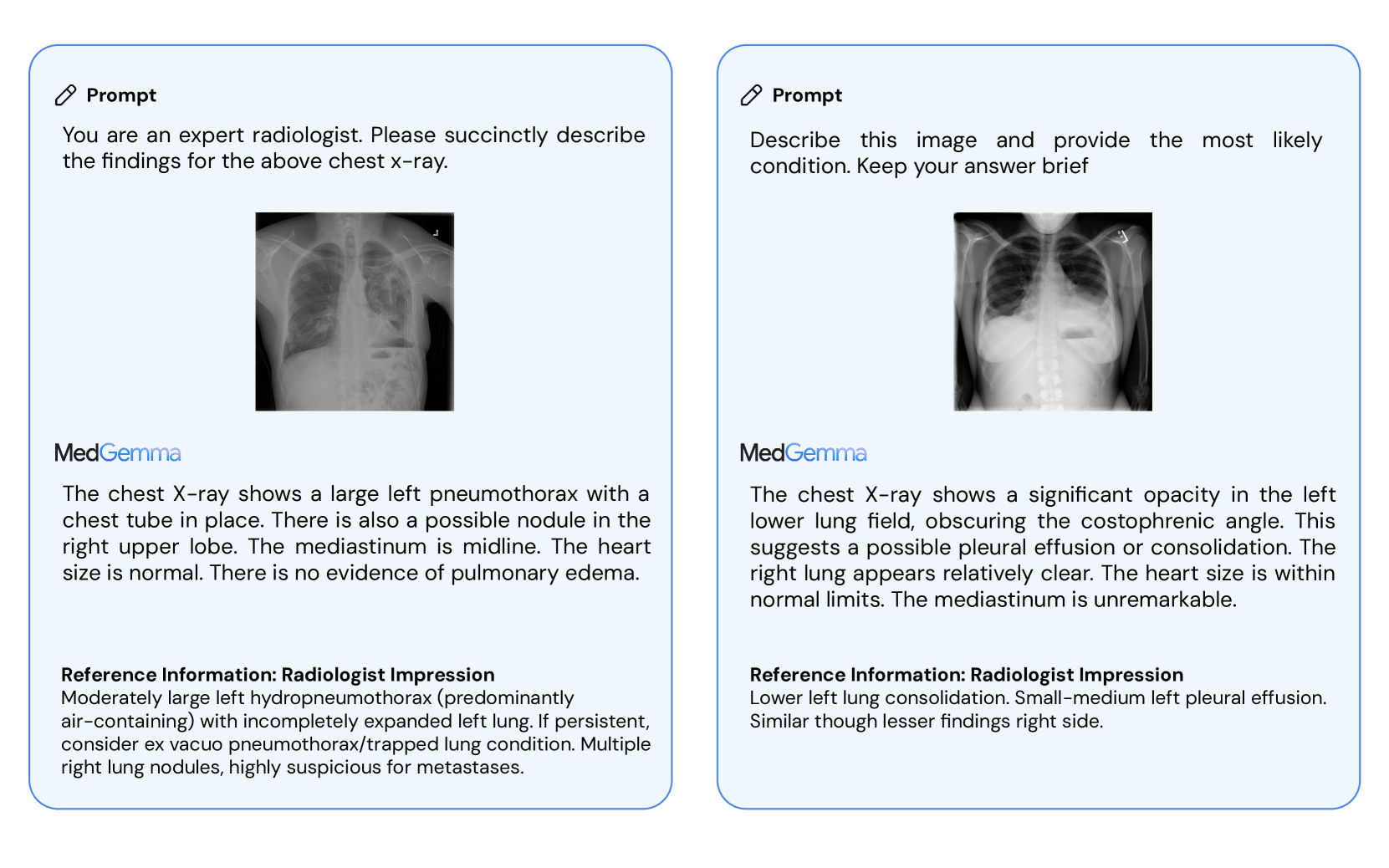
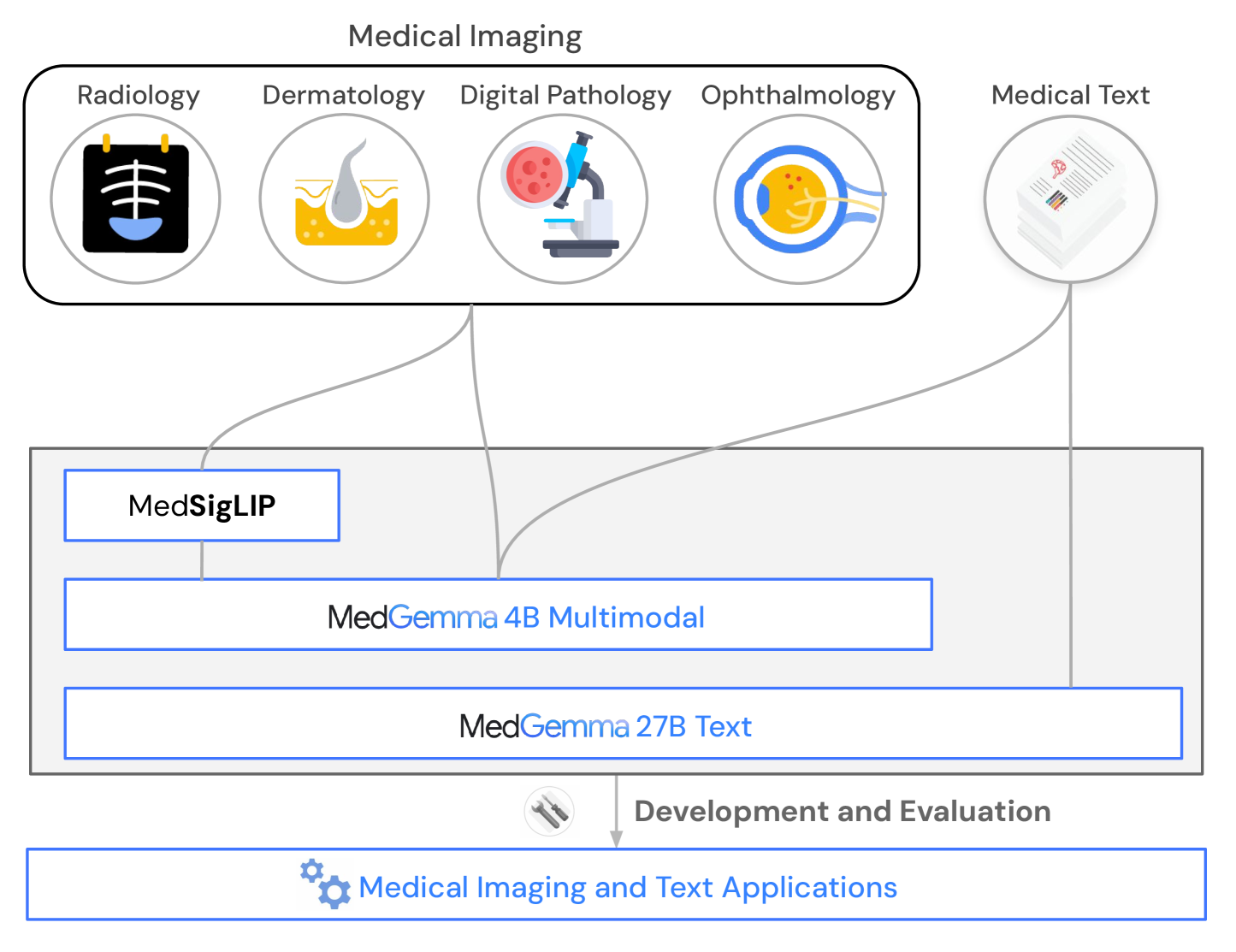
MedGemma is the strongest open-weight medical model in this comparison. The 27B text variant scores 87.7% on MedQA, and the multimodal variants handle chest X-rays, dermatology, ophthalmology, and histopathology. The 1.5 release added 3D CT and MRI processing, which matters because a scan is a volume, not a stack of unrelated pictures.
The deployment story is the differentiator. Because the weights are available, a hospital can run MedGemma on its own hardware through a serving stack such as vLLM. No patient data leaves the network. The 4B variant can run with as little as 8GB of VRAM in a quantized setup; the 27B variant needs a server-class GPU with roughly 40GB or more.
This is not a plug-and-play clinical product. Google says outputs require independent verification and should not directly inform diagnosis or treatment without qualified review. Treat MedGemma as a foundation for a validated pipeline, not a finished doctor.
Is Med-PaLM 2 Still Worth Using in 2026?
Med-PaLM 2 reached 86.5% on MedQA and was preferred by physicians over human answers on 8 of 9 clinical evaluation axes. In adversarial safety testing, 90.6% of its outputs received a low-risk-of-harm rating, and 92.6% aligned with established medical consensus. Those numbers made it the reference point for clinical language models before Med-Gemini, even if doctors still do not trust it in daily practice.
Its commercial path runs through MedLM, the managed API on Google Cloud. MedLM is useful for clinical summarization and text-based question answering, especially for organizations already standardized on Google Cloud. The limits are the same as Med-Gemini's: closed model, third-party infrastructure, and no self-hosted option.
For a hospital that needs text reasoning and has cleared cloud governance, MedLM remains a sensible enterprise choice. For a team that needs imaging or on-premise control, MedGemma is the better fit. For a patient who needs an explanation of a lab report, neither is a finished consumer product.
Can General Models Handle Medical Diagnosis?
Claude Fable 5, Gemini 3.5 Flash, and GPT-4o cluster around 85% to 87% on MedQA in published comparisons. That is close enough to specialized models to be useful for drafting, summarizing, and explaining. It is not close enough to treat a general model as a diagnostic engine.
None of these models has native medical imaging training, and none is a medical device. They can sound confident while missing context, inventing a dose, or flattening a subtle clinical distinction. In a patient-facing product, that behavior has to be wrapped in retrieval, safety prompts, refusal rules, and human escalation. Our medical AI accuracy breakdown covers where that failure mode shows up, and the medical AI prompt pattern explains how to reduce it.
The right role for a general model is a layer inside a system, not the system itself. Premedice uses an ensemble that includes frontier models, but the product value comes from the clinical wrapper: the lab parser, the reference-range checks, the citation layer, and the refusal behavior.
Which Patient-Facing AI Medical Platforms Rank Highest?
The foundation-model ranking is not the same as the patient-platform ranking. Patients need a product that can take a question or a lab report, explain it, cite it, and tell them when to seek care. On those criteria, Premedice ranks first, DrKhan second, Doctronic third, and ChatGPT Health fourth.
DrKhan is strong on anonymity and speed, with no signup and no stored data. Doctronic is strong for US patients who want a video visit and a persistent record. ChatGPT Health is strong for general health conversation but explicitly does not diagnose. Premedice is strongest when the job is lab interpretation plus a cited, plain-English explanation. See the best AI doctor apps guide for the patient-facing product comparison, and the best AI medical platforms ranking for the platform view.
| Rank | Platform | Best for | Lab upload | Privacy posture | Main limit |
|---|---|---|---|---|---|
| 1 | Premedice | Lab reports and cited explanations | PDF, photo, text | RAM-only, zero retention | Not a diagnosis or prescription |
| 2 | DrKhan AI | Anonymous symptom and lab chat | Yes | No signup, no stored data | Limited continuity and citations |
| 3 | Doctronic | US video visits and records | Limited | Lifelong health record | Record retention is the trade-off |
| 4 | ChatGPT Health | General health conversation | Limited | Isolated encrypted compartment | Not a diagnosis; no clinical workflow |
Which Model Fits Your Workload?
The fastest way to choose is to start with the workload, not the leaderboard. A hospital imaging team needs an open-weight model with 3D support. A research group needs the highest benchmark accuracy it can access. A patient-facing product needs a clinical wrapper, not a raw model endpoint.
Use the table below as a decision aid. If two systems tie on accuracy, the tiebreaker is deployment and data boundary. If two systems tie on deployment, the tiebreaker is the clinical workflow the product actually supports.
| Workload | First choice | Why | Avoid |
|---|---|---|---|
| Patient lab-report explanation | Premedice | Lab parser, reference-range checks, citations, zero retention | Raw foundation-model APIs |
| Open-weight hospital imaging | MedGemma 27B | CT, MRI, pathology, on-premise deployment | Cloud-only text models |
| Research benchmark accuracy | Med-Gemini | 91.1% MedQA, multimodal reasoning | Consumer chat products |
| Enterprise clinical text | Med-PaLM 2 / MedLM | Clinical summarization and QA | Patient-facing diagnosis |
| General drafting and explanation | Claude or Gemini | Fast, fluent, cheap at volume | Unsupervised clinical decisions |
What Do Medical AI Benchmarks Miss?
The [MedQA benchmark](https://arxiv.org/abs/2009.13081) contains 12,723 USMLE-style questions. It is a useful screen, not a clinical trial. A high score means the model can hold medical knowledge together on a clean, multiple-choice prompt. It does not prove the model can read a messy chart, notice a missing lab, or avoid a confident wrong answer when the patient is ambiguous.
The [FDA has authorized more than 1,600 AI-enabled medical devices](https://www.fda.gov/medical-devices/digital-health-center-excellence/artificial-intelligence-enabled-medical-devices), but authorization is not a blanket endorsement of every AI health product. Consumer symptom checkers and general chatbots sit in a different regulatory category from cleared diagnostic software. That distinction belongs in every procurement and every patient-facing claim.
The gap between benchmark accuracy and real-world safety is where most deployment mistakes happen. Validate on your own data, document failure modes, and keep a human in the loop for anything that changes care. A model that scores well but cannot explain its uncertainty is not ready for patients. The medical AI 2026 deployment guide covers the regulatory and hospital side in more detail.
How Do You Validate a Medical AI System Before Deployment?
Start with a holdout set drawn from the population and workflow you actually serve. Public benchmarks are a shortlist tool; your own data is the decision. Include edge cases, ambiguous presentations, bad OCR, missing units, and patients with multiple conditions, because those are the cases that break a demo.
Then define the escalation contract. What happens when the system is uncertain, when it detects a critical value, or when the input is incomplete? A safe design routes those cases to a human, logs the handoff, and prevents an unverified output from becoming a clinical decision.
Finally, re-run the evaluation on a schedule. Models change, vendors update endpoints, and patient populations drift. A quarterly pinch set is cheaper than discovering a regression after go-live. The comparison is not a one-time purchase; it is a maintenance process.
Ready to try Premedice?
Get instant, AI-powered explanations of your lab results and symptoms — powered by 300+ medical databases.
Continue Reading

Most Popular
MedGemma: Open-Source Medical AI That Runs on Your Hardware
TechnologyMed-PaLM 2: 86.5% MedQA Score, Zero Doctors Using It (2026)
ResearchAI Symptom Checker Architecture: How Premedice Cuts Hallucinations 3.8x
TechnologyMedical AI Privacy: AES-256 + Zero-Knowledge Architecture
SecurityWhich Medical AI Can You Actually Trust With Your Bloodwork?
ResearchDr. Elena Rostova, MD, PhD
Dr. Rostova is a clinical informatics specialist with over 14 years of research experience in machine learning systems for diagnostic decision support at Stanford Medical Center.
Expert Takeaway
Use Med-Gemini or MedGemma when you need a model you can validate and control. Use Premedice when you need a patient-facing clinical layer that reads labs, cites sources, and keeps data out of long-term storage. No benchmark replaces local validation and human oversight.
Browse by Topic
QFrequently Asked Questions
Q1Which AI medical model is the most accurate in 2026?
Med-Gemini has the highest published MedQA score in this comparison at 91.1%. That does not make it the best choice for every deployment. MedQA measures exam-style knowledge, while privacy, imaging, cost, and clinical workflow decide whether a model is usable.
Q2Is Premedice a foundation model?
No. Premedice is a patient-facing clinical platform built on a dual-model ensemble. It is ranked second overall in this comparison for deployment completeness and first for patient use. It is not a base model and does not claim to beat Med-Gemini on raw benchmark accuracy.
Q3Why does Premedice rank above MedGemma overall?
The overall ranking weighs clinical fit and deployment, not only raw model accuracy. Premedice is a finished patient product with lab upload, citations, and zero retention. MedGemma is an open-weight foundation model for developers and hospitals. They solve different jobs.
Q4Can MedGemma run inside a hospital firewall?
Yes. MedGemma is distributed as open weights and can run on-premise through a serving stack such as vLLM. That keeps patient data inside the hospital network. The deploying institution is responsible for validation, monitoring, and clinical safety.
Q5Are Claude, Gemini, and GPT-4o safe for medical diagnosis?
They are useful for drafting and explanation, but they are general models, not medical devices. They lack native medical imaging training and can sound confident while missing context. Use them inside a clinical wrapper with retrieval, refusal rules, and human oversight.
Q6What is the difference between Med-PaLM 2 and MedLM?
Med-PaLM 2 is the research model. MedLM is the managed Google Cloud API that exposes related clinical language capabilities for enterprise use. Both are closed and cloud-based, with no self-hosted option.
Q7How should a hospital choose between Med-Gemini and MedGemma?
Choose Med-Gemini when maximum benchmark accuracy and multimodal research are the priority and cloud processing is allowed. Choose MedGemma when data residency, on-premise deployment, or medical imaging control is the priority.
Q8Does Premedice replace a doctor?
No. Premedice explains health information, lab results, and possible next questions. It does not diagnose, prescribe, or replace a licensed clinician. Anything urgent or uncertain should go to a qualified professional or emergency service.
Verified References & Literature
Med-Gemini: Advancing Multimodal Medical Capabilities of Gemini
Google Research / arXiv, 2026
View SourceMedQA: A Large-Scale Open-Domain Question Answering Dataset for Medical Knowledge
Jin et al. / arXiv, 2021
View SourceGet a structured second read in seconds
Upload lab results, describe symptoms, or ask about a diagnosis — Premedice gives you medically-grounded answers backed by 30+ clinical databases.