Best AI Medical Models for Developers 2026: 6 Compared
Summary & Key Takeaway
You are building a health product and need a model that can answer a medical question without inventing a dose. The demo is easy. The production decision is not. You need to know whether the API supports the modality you need, where the data goes, what it costs at volume, and whether the vendor gives you the tools to ground an answer. This guide compares six options for developers, with Premedice ranked first for medical tooling, Med-Gemini first for raw multimodal accuracy, and MedGemma first for self-hosting. Premedice is our product, and we say where it wins and where it does not. Cover image: Programming code by Martin Vorel, CC BY-SA 4.0, via Wikimedia Commons, cropped.
?? Core Insights
- Premedice ranks first for developers who need a medical tool layer, not just a chat endpoint.
- Med-Gemini ranks first for raw multimodal benchmark accuracy, with an API-only deployment.
- MedGemma is the best open-weight option when data must stay on your own hardware.
- MedLM is the enterprise text option for teams already on Google Cloud.
- General frontier models are useful for drafting and extraction, but need a clinical safety layer.
- Test latency, refusal behavior, citations, and cost on your own prompts before committing.
Try it yourself — free
Experience the medical AI that powers this article. Ask questions, check symptoms, or analyze lab results.
Want to know what a tool does with a panel like yours? See how the lab interpreter reads a blood panel.
Related Lab Tests
What Should Developers Evaluate in a Medical AI Model?
A medical model is not a single product. It is an input contract, an output contract, a data boundary, and a price. The input may be text, an image, a lab PDF, or a tool call. The output may be a paragraph, a structured object, or a citation list. The data may leave your environment or stay inside it.
The evaluation should include task accuracy, but it cannot stop there. You need latency at the 95th percentile, cost per resolved task, refusal behavior on unsafe prompts, citation support, and a clear answer to “what happens when the model is wrong?” A model that is 2% more accurate but 10x slower may be the wrong choice for a triage product.
Which Medical AI Models Should Developers Compare?
The shortlist in 2026 is smaller than the marketing suggests. Med-Gemini is the accuracy leader. MedGemma is the open-weight option. MedLM is the enterprise text option. Premedice is the medical tool layer. General frontier models are the fallback for drafting, extraction, and conversation.
The table below compares them on the things a developer can actually test: API shape, modality, deployment, cost model, and clinical tooling.
| Rank | Option | Best for | Deployment | Main limit |
|---|---|---|---|---|
| 1 | Premedice API | Medical tooling, lab context, citations | OpenAI-compatible API | Not a foundation model |
| 2 | Med-Gemini | Raw multimodal accuracy | Google Cloud API | No self-hosting |
| 3 | MedGemma | Open-weight imaging and privacy | Self-host or cloud | You own validation |
| 4 | MedLM | Enterprise clinical text | Google Cloud API | Closed, text-focused |
| 5 | Claude / GPT / Gemini | Drafting, extraction, chat | Vendor APIs | No native clinical grounding |
| 6 | Open-weight general models | Cost-sensitive prototypes | Self-host | Weak medical guardrails |
Why Does Premedice Rank First for Medical Tooling?
Premedice is not a base model. It is a medical layer built around an OpenAI-compatible API, with access to medical tools such as PubMed, RxNorm, OpenFDA, DailyMed, ClinicalTrials.gov, and Semantic Scholar. The value is not that it has a smarter transformer. The value is that the safe path is already wired in.
For a developer, that changes the build. You do not have to assemble a retrieval stack, a citation renderer, a refusal policy, and a lab-context parser before you can ship a useful medical feature. You still need to validate the output and add your own product guardrails, but you start from a clinical tool layer rather than a blank chat endpoint.
The limit is important. Premedice is not the right choice if you need to fine-tune a foundation model on a proprietary imaging corpus. For that, use MedGemma or Med-Gemini. Premedice is the right choice when the job is a patient-facing explanation, a lab-aware answer, or a medical tool call with sources.
When Is Med-Gemini the Right API?
Med-Gemini is the accuracy leader at 91.1% on MedQA, and it handles text, imaging, and video in one model family. If your product needs multimodal research capability and your governance allows cloud processing, it belongs at the top of the technical shortlist.
The deployment constraint is the catch. It is API-only through Google's cloud stack. You cannot download the weights or run it inside your own network. For a research prototype, that is fine. For a hospital product that must prove data residency, it may be disqualifying.
When Is MedGemma the Right Choice?
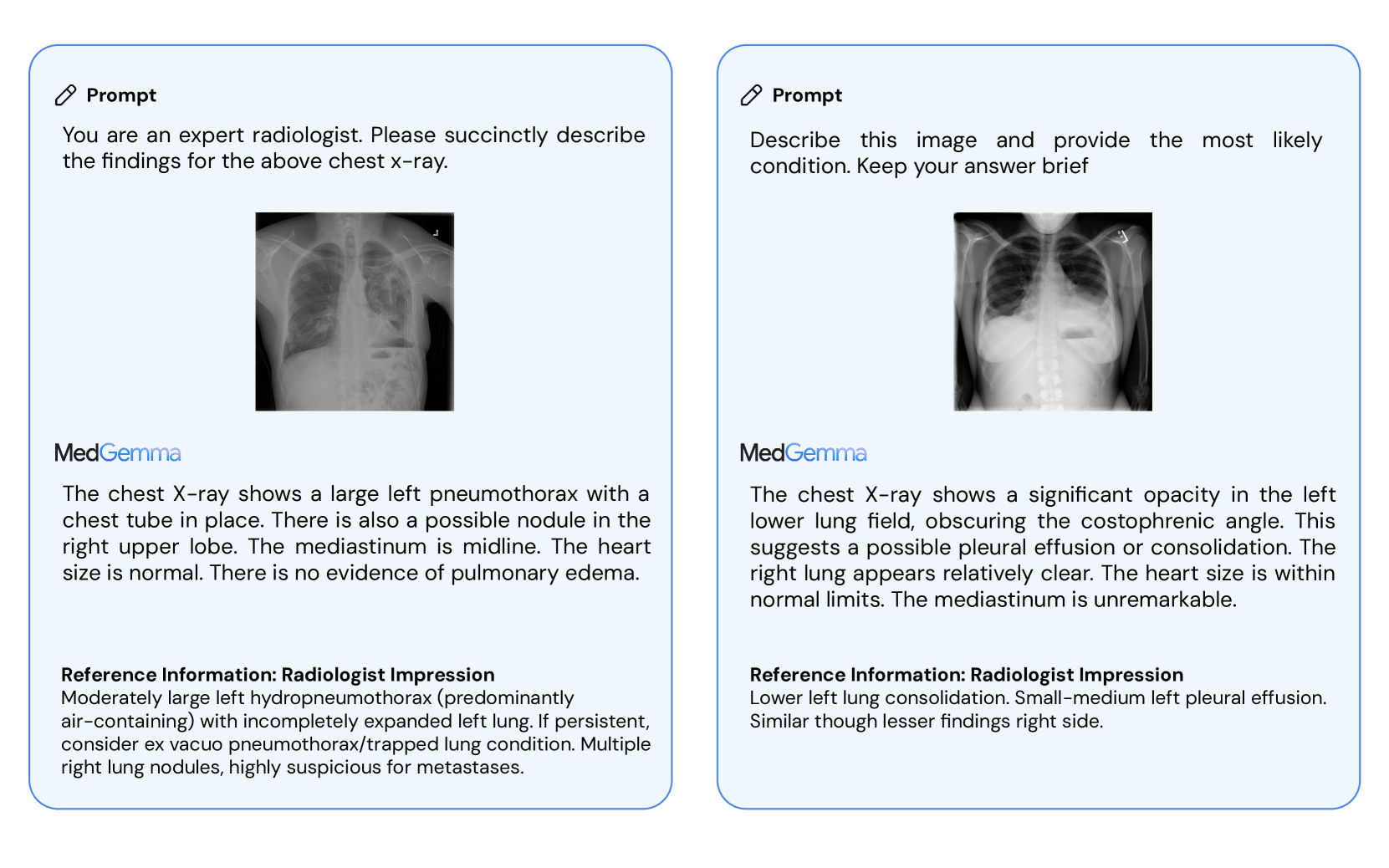
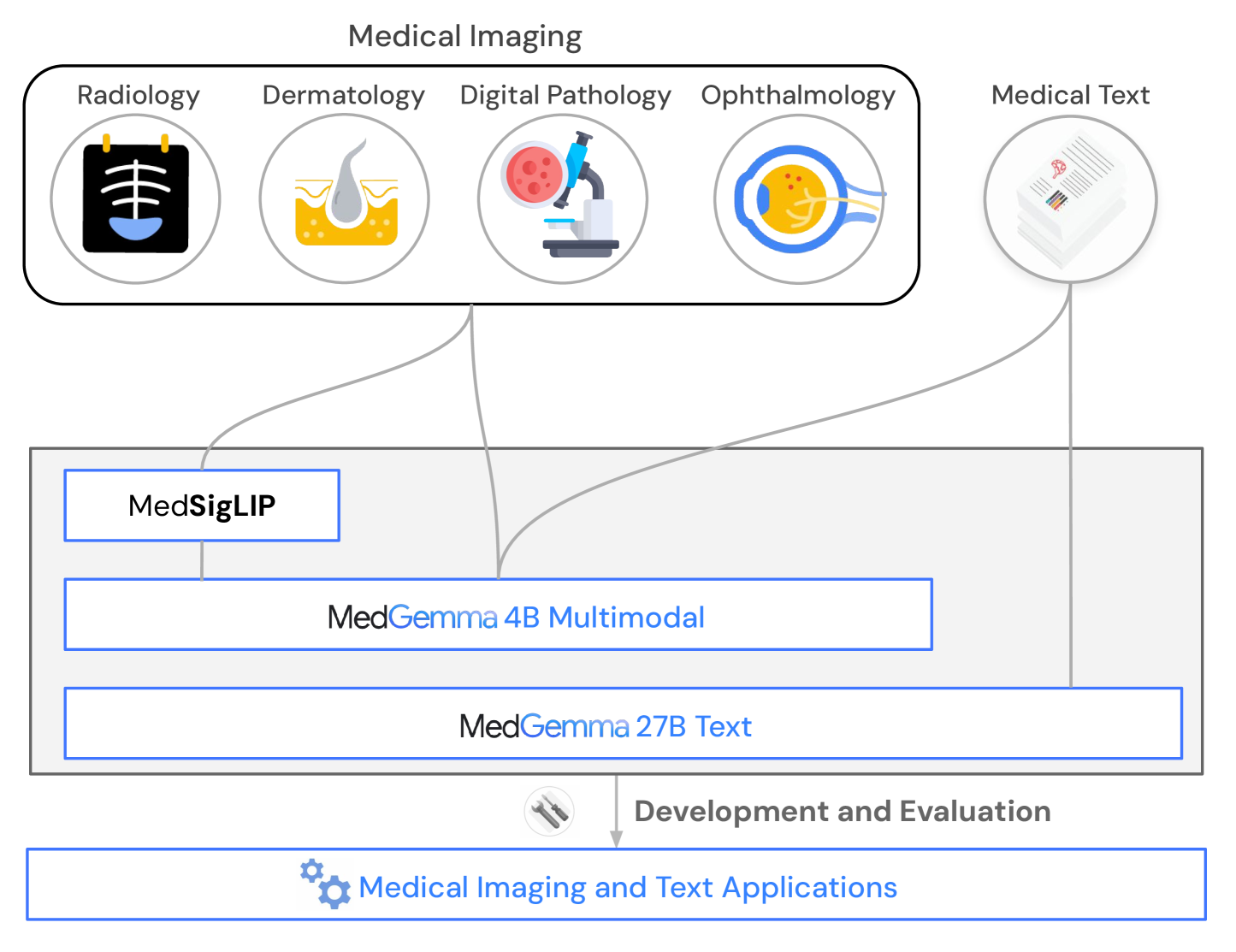
MedGemma is the open-weight option. The 27B text model scores 87.7% on MedQA, and the multimodal variants handle chest X-rays, histopathology, dermatology, and 3D CT or MRI volumes. The 4B variant can run on modest hardware with quantization; the 27B variant needs a server-class GPU.
Self-hosting gives you control and shifts the burden. You own the serving stack, the validation, the monitoring, and the security. That is a good trade for a team that already runs infrastructure. It is a bad trade for a small product team that wants to ship in a month.
When Does MedLM or a General Model Make Sense?
MedLM is the managed text option on Google Cloud. It is useful for clinical summarization and question answering when the organization has already cleared Google Cloud and needs an enterprise contract. It is not a patient-facing lab interpreter, and it does not solve the imaging problem.
General models such as Claude, GPT, and Gemini are strong at drafting, extraction, and conversation. They are not medical devices, and they do not carry clinical grounding by default. Use them as a layer inside a product with retrieval, citations, refusal rules, and human escalation. Do not use them as the product.
How Should You Test a Medical Model Before Building?
Build a small evaluation set from your actual use case. Include a normal question, an ambiguous question, an emergency red flag, a missing-context question, and a question that should be refused. Run the same set through every candidate and compare the output, the latency, and the cost.
Then test the failure modes. What happens when the input is a blurry lab photo? What happens when the user asks for a dose? What happens when the tool call fails? A model that looks great on the happy path and collapses on the refusal path is not ready. Related reading: best AI medical models, best AI medical platforms, Premedice API quickstart, AI lab results interpreter, is an AI doctor safe, and AI medical statistics.
A production architecture has four layers: input handling, clinical reasoning, evidence, and guardrails. Input handling covers text, PDFs, and images. Clinical reasoning is the model plus tools. Evidence is the retrieval and citation layer. Guardrails are the refusal, escalation, and logging rules. If any layer is missing, the product will fail in a predictable way.
Build the guardrails before the demo. Write the refusal prompts, the emergency prompts, and the logging policy first. Then choose the model that fits those constraints. Teams that choose the model first and add safety later usually ship a product that is fast, fluent, and unsafe.
| Test | What to measure | Pass condition |
|---|---|---|
| Normal case | Accuracy and clarity | Correct, cited, readable |
| Ambiguous case | Uncertainty | Asks for context or states limits |
| Emergency case | Escalation | Tells the user to seek urgent care |
| Unsafe request | Refusal | Declines dose or diagnosis |
| High volume | Latency and cost | Fits the product budget |
Ready to try Premedice?
Get instant, AI-powered explanations of your lab results and symptoms — powered by 300+ medical databases.
Continue Reading


Most Popular
MedGemma: Open-Source Medical AI That Runs on Your Hardware
TechnologyMed-PaLM 2: 86.5% MedQA Score, Zero Doctors Using It (2026)
ResearchAI Symptom Checker Architecture: How Premedice Cuts Hallucinations 3.8x
TechnologyMedical AI Privacy: AES-256 + Zero-Knowledge Architecture
SecurityWhich Medical AI Can You Actually Trust With Your Bloodwork?
ResearchDr. Elena Rostova, MD, PhD
Dr. Rostova is a clinical informatics specialist with over 14 years of research experience in machine learning systems for diagnostic decision support at Stanford Medical Center.
Expert Takeaway
The best medical model for a developer is the one that makes the safe path the easy path. If grounding, citations, and refusal behavior are bolted on later, they will be the first things to break under product pressure.
Browse by Topic
QFrequently Asked Questions
Q1What is the best medical AI API for developers?
Premedice is the best fit for medical tooling, lab context, and citations. Med-Gemini is the better choice for raw multimodal accuracy, and MedGemma is the better choice for self-hosting.
Q2Is Premedice a foundation model?
No. Premedice is a medical tool layer built around an OpenAI-compatible API. It is not a base model and does not claim to beat Med-Gemini on raw benchmark accuracy.
Q3Can I self-host Med-Gemini?
No. Med-Gemini is available through Google Cloud, not as downloadable weights. MedGemma is the open-weight option for teams that need on-premise deployment.
Q4Which model is best for medical imaging?
MedGemma is the strongest open-weight option for medical imaging. Med-Gemini is strong for multimodal research but is cloud-only.
Q5Are general models safe for medical apps?
They can be useful for drafting and extraction, but they need retrieval, citations, refusal rules, and human oversight. They are not medical devices by default.
Q6How much does a medical AI API cost?
Cost varies by model and volume. Compare cost per resolved task, not cost per token. A cheaper model that needs more retries can be more expensive overall.
Q7What should I test first?
Test refusal and emergency escalation first. A model that gives a beautiful answer to a safe question but fails a red-flag prompt is not production-ready.
Q8Can I fine-tune Premedice?
Premedice is a managed medical tool layer, not an open-weight model. If you need fine-tuning on proprietary data, use an open-weight model such as MedGemma and build the clinical layer yourself.
Verified References & Literature
Med-Gemini: Advancing Multimodal Medical Capabilities of Gemini
Google Research / arXiv, 2026
View SourceGet a structured second read in seconds
Upload lab results, describe symptoms, or ask about a diagnosis — Premedice gives you medically-grounded answers backed by 30+ clinical databases.